
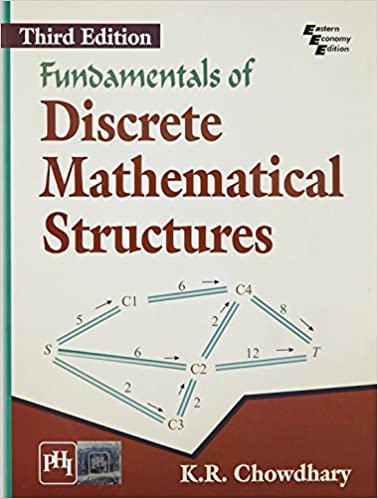
Fundamentals of Discrete Mathematical Structures
Third Edition
Author: Prof. K. R. Chowdhary
Publisher: PHI Learning
ISBN: 9788120350748
About the Book
Fundamentals of Discrete Mathematical Structures provides a comprehensive introduction to the mathematical foundations required for the study of Computer Science and Information Technology. The book presents discrete mathematical concepts together with their relevance to computing, algorithms, programming, and problem solving.
The mathematical concepts are developed systematically through definitions, propositions, theorems, examples, and exercises. Particular emphasis is placed on developing mathematical reasoning and demonstrating how discrete structures are used in Computer Science.
Major Topics
- Mathematical logic and mathematical reasoning
- Sets, relations, and functions
- Combinatorics and counting techniques
- Recurrence relations
- Graph theory and graph algorithms
- Partially ordered sets and lattices
- Algebraic structures, groups, and subgroups
- Applications of discrete mathematics in Computer Science
Third Edition
The third edition has been expanded with additional sections, examples, definitions, theorems, exercises, and GATE-oriented multiple-choice questions with answers. New and expanded material includes recurrence relations, Peano axioms, graph algorithms, lexicographic ordering, chains and antichains, order-isomorphism, complemented lattices, cyclic and Abelian groups, automorphism groups, group homomorphisms, permutation groups, cosets, and quotient subgroups.
Who Should Read This Book?
The book is primarily intended for undergraduate students of Computer Science and Engineering and Information Technology. It is also useful for students of Computer Applications at undergraduate and postgraduate levels, teachers of discrete mathematics, and students preparing for competitive and university examinations.
Why Discrete Mathematics for Computer Science?
Discrete mathematics forms the mathematical foundation of many areas of Computer Science. Concepts such as logic, relations, graphs, recurrence relations, combinatorics, lattices, and algebraic structures occur naturally in algorithms, programming languages, databases, computer networks, artificial intelligence, theory of computation, and software engineering.
This book is intended to help students build that foundation while developing the ability to apply mathematical ideas to computational problems.