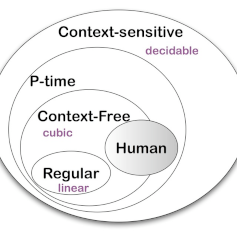
Theory of Formal Languages — Lecture Notes and Course Materials
This page provides open educational resources for the study of Theory of Formal Languages, with emphasis on advanced topics in formal languages, computability, Turing machines, decidability, recursive functions, and lambda calculus.
The material is intended for undergraduate and postgraduate students, teachers, researchers, and independent learners interested in the mathematical foundations of Computer Science and the formal study of computation.
The course extends the basic concepts normally introduced in an undergraduate Theory of Computation course and provides a foundation for higher studies and research in areas such as computability theory, complexity theory, formal methods, cryptography, and programming-language analysis.
What You Will Find
- Lecture notes on Turing machines and their variants
- Universal Turing machines and computational models
- Linear bounded automata and context-sensitive languages
- Turing-computable and primitive recursive functions
- Partially computable and recursive functions
- Decidability and undecidability
- Recursive and recursively enumerable languages
- Time and space bounded computation
- Lambda calculus and its relationship with computation
Course Information
Prerequisites
- Computer Fundamentals and C Programming
- Computer Architecture
- Theory of Computation
- Fundamentals of Discrete Mathematical Structures, III Edition (With GATE Problems), ISBN: 978-81-203-5074-8
Course Objectives
The objective of the Theory of Formal Languages course is to develop an understanding of formal languages and computation beyond the basic theory normally covered in an undergraduate Theory of Computation course. The course examines Turing machines and their variants, the complexity of computation on these models, and the concept of the Universal Turing Machine.
The course also studies computable functions, primitive recursive functions, partial functions, computable predicates, and semi-computable and non-computable functions.
Further topics include decidability and computability, decidable and undecidable languages, recursive and recursively enumerable languages, and lambda calculus.
Learning Outcomes
- Understand the distinction between computable, partially computable, and non-computable problems and functions.
- Understand the mathematical theory of computable and recursive functions.
- Analyze recursive and recursively enumerable languages.
- Understand decidable and undecidable problems and their relationship to computational models.
- Analyze variants of Turing machines and their computational capabilities.
- Understand the role of Universal Turing Machines in the theory of computation.
- Understand the relationship between Turing machines, primitive recursive functions, and lambda calculus.
- Apply formal methods of computation to advanced studies and research in Computer Science.
Lecture Notes and Course Modules
Module 1: Turing Machines and Their Variants
Topics Covered
- Introduction to Turing machines
- Turing machines and language recognition
- Turing machines and computability
- Two-tape, three-tape and k-tape Turing machines
- Variants of Turing machines
- Universal Turing machines
Learning Resources
Module 2: Linear Bounded Automata and Context-Sensitive Languages
Topics Covered
- Linear bounded automata
- Context-sensitive languages
- Relationship between bounded computation and conventional computers
- Properties and theoretical foundations of context-sensitive languages
Learning Resources
Module 3: Computable Functions
Topics Covered
- Computability and computable functions
- Turing-computable functions
- Primitive recursive functions
- Implementation of primitive recursive functions on Turing machines
- Sequential operations of Turing machines
- Primitive recursive predicates
- Partially computable functions
- Recursive functions
- Ackermann's function
Learning Resources
- Turing Computable Functions
- Primitive Recursive Functions
- Implementing Primitive Recursive Functions on Turing Machines
- Sequential Operations of Turing Machines
- Primitive Recursive Functions are Computable and Primitive Recursive Predicates
- Partially Computable Functions, Recursive Functions and Ackermann's Function
Module 4: Decidability and Undecidability
Topics Covered
- Decision problems
- Decidable and undecidable problems
- Recursive languages
- Recursively enumerable languages
- Turing-recognizable languages
- Decidability and computability
- Decidable properties of regular languages
- Time- and space-bounded Turing machines
- Type-0 grammars and linear bounded automata
Learning Resources
Module 5: Lambda Calculus
Topics Covered
- Introduction to lambda calculus
- Lambda calculus as a formal model of computation
- Church's contribution to the theory of computation
- Relationship between Turing machines and lambda calculus
- Relationship between primitive recursive functions and formal models of computation
Learning Resources
About These Lecture Notes
These lecture notes have been developed as teaching material for advanced study of formal languages, computability, and theoretical Computer Science.
The material is intended to complement standard textbooks and classroom instruction. Readers are encouraged to study the underlying mathematical arguments carefully and to consult additional scholarly references for deeper treatment of computability theory and formal language theory.
The subject provides an important theoretical foundation for higher studies and research in areas including theoretical Computer Science, complexity theory, formal methods, programming languages, cryptography, and program analysis.
Related Computer Science Resources
Theory of Formal Languages is closely related to several other areas of Computer Science. Related learning resources available on this website include:
Further Reading
For further study, readers may consult standard references in Theory of Computation, Formal Languages, Computability Theory, and Discrete Mathematical Structures.
Fundamentals of Discrete Mathematical Structures, III Edition (With GATE Problems)